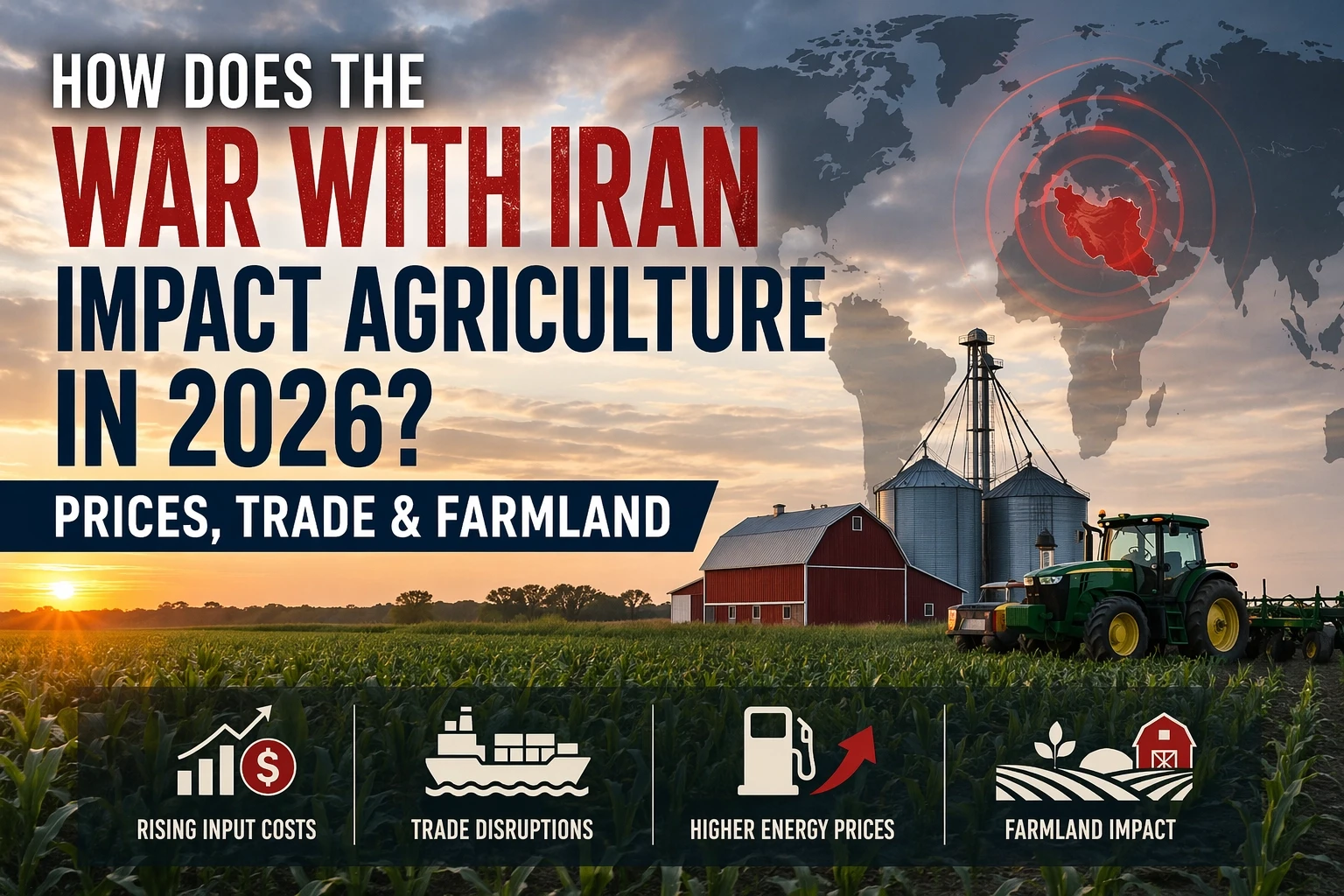
How Does the War With Iran Impact Agriculture in 2026?
Prices, Trade & Farmland
By Nolan Sampson
I’m Nolan Sampson, a farmland real estate agent and farm manager serving clients across Indiana and Michigan. My work centers around helping landowners and operators make sound, long-term decisions—whether that’s managing farmland, navigating leases, or evaluating buying and selling opportunities.
In today’s environment, those decisions are being shaped by something far bigger than local markets: global conflict. The 2026 war involving Iran is already having real, measurable impacts on agriculture here in the Midwest. From input costs to commodity prices and ultimately farmland values, this situation is worth understanding.
Let’s break down what’s happening—and what it means for farmers, landowners, and investors.
The Big Picture: Why This War Matters to Agriculture
The Iran conflict has disrupted one of the most important chokepoints in global trade: the Strait of Hormuz. This region is critical not just for oil, but for fertilizer and energy inputs that agriculture depends on.
When that system gets disrupted, agriculture feels it quickly—and often painfully.
The result in 2026:
Higher fertilizer prices
Increased fuel and input costs
More volatile commodity markets
Uncertainty in global trade
For Midwest agriculture, this is not theoretical—it’s already showing up in balance sheets.
Fertilizer Prices: The Immediate Pressure Point
If there’s one area where this conflict hits hardest, it’s fertilizer.
Fertilizer prices have surged as much as 40% in 2026 due to supply disruptions.
Roughly one-third of global fertilizer supply moves through the Strait of Hormuz, making it highly vulnerable.
Nitrogen prices have jumped dramatically, in some cases nearly doubling from prior levels.
From a farm management standpoint, timing matters:
Farmers who pre-purchased inputs are relatively protected
Those buying in-season are absorbing significantly higher costs
What this means:
Pressure on margins, especially for corn-heavy operations
Potential shift toward lower-input crops like soybeans
Increased importance of cost control and planning
This is where strong farm management becomes critical—input decisions today will directly impact profitability this fall.
Energy & Fuel Costs: The Hidden Multiplier
Fertilizer isn’t the only issue. Energy prices are rising as well.
Oil prices surged significantly following the conflict
Fuel, drying, transportation, and chemical costs all increase alongside energy
And here’s the key: energy drives fertilizer production. Up to 70% of nitrogen fertilizer cost is tied to energy inputs.
So when energy rises, it compounds everything.
On the farm:
Higher diesel costs for planting and harvest
Increased trucking and basis pressure
Elevated grain drying costs
This is squeezing profitability from both sides—higher costs and uncertain revenues.
Commodity Prices: A Mixed Outlook
You might expect higher costs to automatically lead to higher crop prices—and in some cases, they do.
But the reality is more complicated.
Bullish factors:
Reduced fertilizer use could tighten supply
Lower global yields may support grain prices
Bearish factors:
Global competition (especially Brazil in soybeans) remains strong
Trade disruptions limit export demand
Broader economic uncertainty weighs on markets
Bottom line:
We’re in a volatile environment, not a guaranteed price rally.
That’s why marketing strategy and risk management matter more than ever.
Global Trade Disruptions: The Bigger Risk
The Strait of Hormuz isn’t just about inputs—it’s also about trade.
Fertilizer, fuel, and agricultural goods all rely on global shipping routes
Disruptions increase costs and delays
Countries may shift sourcing, altering long-term trade relationships
We’ve already seen how quickly trade dynamics can shift in recent years. This conflict adds another layer of uncertainty.
For U.S. agriculture, that means:
Export demand can change quickly
Competitor countries may gain market share
Policy responses could reshape markets
What This Means for Farmland Values
Now let’s bring this back to what I focus on every day—farmland.
Despite all this volatility, farmland historically behaves differently than other assets.
Short-term pressures:
Higher input costs reduce farm profitability
Interest rate uncertainty impacts borrowing
Cash rent margins may tighten
Long-term support:
Strong balance sheets in agriculture
Inflation protection characteristics of land
Limited supply of high-quality farmland
Even in uncertain times, farmland remains a long-term asset class, not a short-term speculation.
Key insight:
Periods like this often separate:
Well-managed operations from struggling ones
Strategic buyers from reactive sellers
Farm Management Matters More Than Ever
In an environment like 2026, farm management isn’t just helpful—it’s essential.
The difference between profitability and loss may come down to:
Input purchasing strategy
Lease structure and flexibility
Crop planning decisions
Marketing timing
This is where I spend most of my time with clients—helping them navigate uncertainty with a clear plan.
Final Thoughts: Uncertainty Creates Opportunity
The war with Iran is a reminder of something agriculture has always faced:
We operate in a global system, whether we like it or not.
Yes, there are real challenges:
Higher costs
Market volatility
Trade uncertainty
But there are also opportunities:
Stronger commodity prices in certain scenarios
Strategic land acquisitions
Improved management efficiencies
The key is being proactive—not reactive.
Let’s Talk About Your Farm
If you’re a landowner, farmer, or investor trying to make sense of this market, I’d be glad to help.
Whether it’s:
Farm management
Farmland real estate
Leasing strategy
Buying or selling land
Reach out anytime to have a conversation.