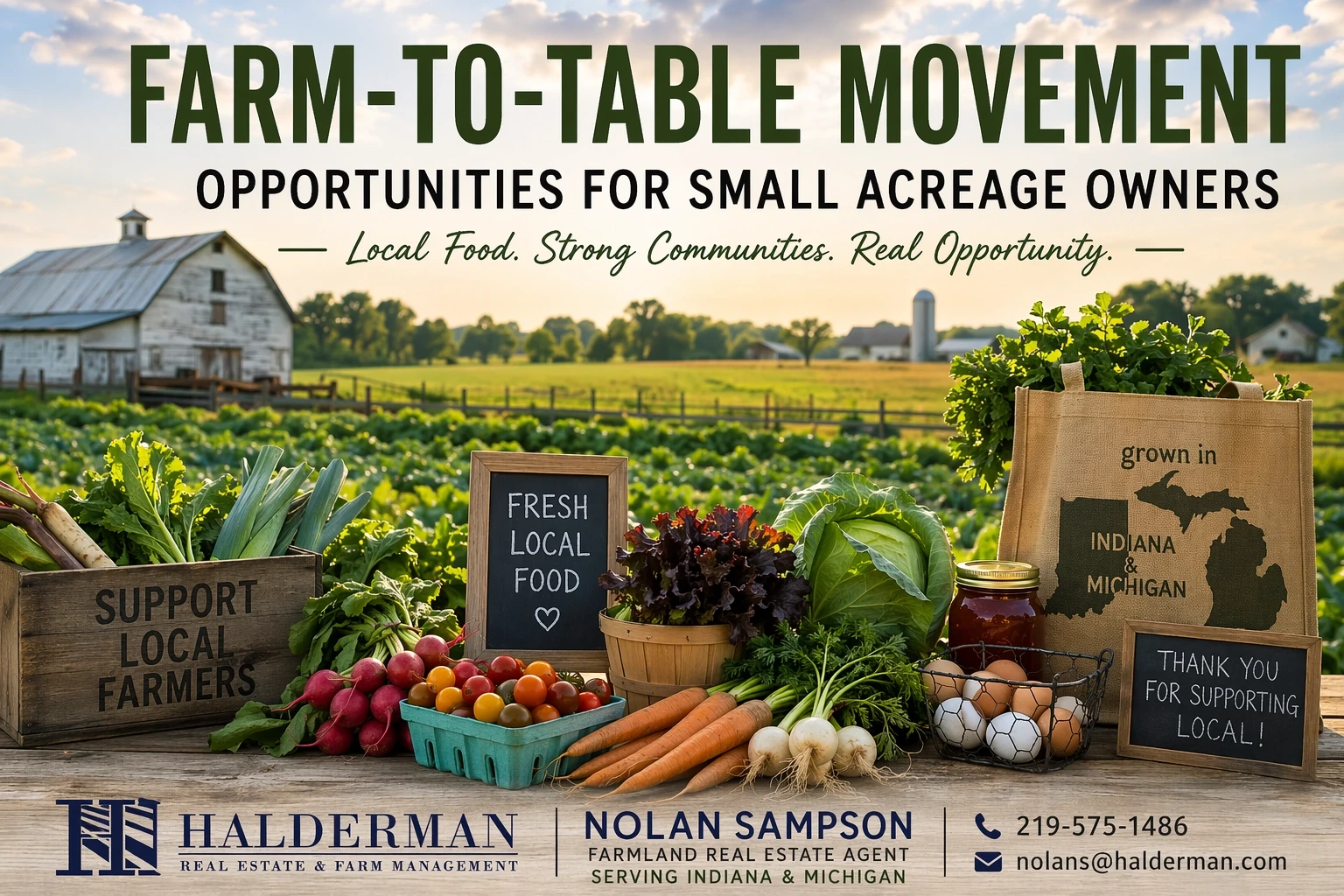
Farm-to-Table Movement: Opportunities for Small Acreage Owners in Indiana and Michigan
Introduction
My name is Nolan Sampson, and I’m a farmland real estate agent serving clients across Indiana and Michigan. Day in and day out, I work with landowners—from large-scale row crop operators to folks managing 5, 10, or 40 acres trying to figure out what that land can really do.
One of the biggest shifts I’ve seen over the past several years is the rise of the farm-to-table movement—not just as a buzzword, but as a real economic driver for small acreage farming in our region.
This isn’t a coastal trend anymore. It’s happening right here in Northwest Indiana, across Michigan, and throughout the Midwest. And for the right landowner, it creates a very real opportunity to generate income, build a business, and connect directly with the local market.
What Farm-to-Table Actually Means (In Our Region)
At its core, farm-to-table is about shortening the distance between the farm and the consumer—whether that’s a restaurant, grocery store, or family buying directly from you.
But here in Indiana and Michigan, it goes a step further.
It’s about:
Local farmers supplying local communities
Transparency—people knowing where their food comes from
Building a regional food system, not just individual farms
Organizations like the Northwest Indiana Food Council are actively building infrastructure to support this—connecting farmers, buyers, and communities through programs and even wholesale food hubs.
And here’s the reality most people don’t realize:
Indiana produces a lot of food—but most of what we eat isn’t grown here.
That gap is where opportunity lives.
Why Small Acreage Farming Is Positioned to Win
Large farms still dominate commodity production—and they should. But the farm-to-table market is different. It rewards proximity, flexibility, and direct relationships.
That’s where small acreage owners have the advantage.
1. You’re Closer to the Customer
In Northwest Indiana, you’re within reach of:
Chicago (major premium market)
South Bend / Mishawaka
Valparaiso / Crown Point
Southwest Michigan tourism markets
That proximity matters. Farm-to-table depends on freshness and logistics, and smaller farms can move product quickly—sometimes within 24 hours of harvest.
2. You Can Produce What the Market Actually Wants
Commodity farming is price-driven. Farm-to-table is demand-driven.
Small acreage farms can focus on:
Fresh vegetables and specialty crops
Herbs, greens, and greenhouse production
Pasture-raised meat and eggs
Value-added products like jams, cheese, or baked goods
SARE research highlights that value-added products are a major opportunity—because customers will pay more for something ready to use or unique.
3. You Can Sell Direct (And Keep the Margin)
Instead of selling into a commodity system, farm-to-table allows:
Farmers markets
CSAs (subscription models)
On-farm stores
Restaurant partnerships
Food hubs like Region Roots
That last one is important—Northwest Indiana now has a structured distribution channel for local food, which didn’t exist 10–15 years ago.
What’s Driving Demand in Indiana and Michigan
This isn’t just consumer preference—it’s structural.
1. Supply Chain Awareness
COVID exposed weaknesses in national supply chains. Local systems proved they could adapt faster and fill gaps.
That changed how people think about food.
2. Growth of Regional Food Systems
There is real investment happening right now:
USDA-backed regional food business centers supporting Midwest producers
Statewide food council networks building connections and resources
Local infrastructure being built for aggregation and distribution
This is no longer informal—it’s becoming organized.
3. Consumer Shift Toward Local and Transparent Food
Consumers want:
Fresh, seasonal products
Locally sourced meat and produce
A relationship with the farmer
And importantly—they’re willing to pay for it.
Best Farm-to-Table Opportunities for Small Acreage Owners
From what I’ve seen working with clients, these are the most realistic and profitable paths in our region:
Specialty Crop Production
Mixed vegetables
Salad greens / hydroponics
Berries and orchard crops (especially in Michigan)
These generate high revenue per acre, which is critical for small parcels.
Livestock (Done Right)
Pasture-raised beef (small herds)
Poultry and egg production
Niche pork or lamb
The key here is branding and direct sales—not volume.
Value-Added Products
This is one area many landowners overlook.
Examples:
Jams, syrups, sauces
Cheese or dairy products
Prepared foods
SARE emphasizes this because it multiplies the value of what you produce, not just the volume.
Agritourism (Huge in Michigan, Growing in Indiana)
U-pick operations
Farm dinners
Seasonal events
This works especially well near:
Lake Michigan corridors
Tourist-heavy areas
Urban fringe markets
What Makes or Breaks a Small Acreage Operation
This is where I see people either succeed—or struggle.
What Works
Strong location (near population centers)
Good road access and visibility
Water availability (non-negotiable for produce)
Clear marketing plan
What Doesn’t Work
Trying to farm like a 1,000-acre operation on 10 acres
No direct-to-consumer strategy
Ignoring the business side (pricing, branding, relationships)
Farm-to-table is not just farming—it’s farming + marketing + logistics.
The Real Estate Side: Why This Matters
From my perspective as a farmland broker, this trend is directly influencing land demand.
We’re seeing increased interest in:
5–40 acre properties
Parcels near towns or commuter corridors
Land with existing buildings or infrastructure
Because buyers aren’t just looking for “land”—they’re looking for income-producing potential tied to the local food economy.
And as demand for local food grows, so does the value of land that can support it.
Getting Started (The Right Way)
If you’re a landowner considering this path, here’s my advice:
Start With the Market, Not the Crop
Figure out who you’re selling to before you plant anything.
Start Small and Prove the Model
Test your concept on a few acres before scaling.
Build Relationships Early
Restaurants, buyers, food hubs, and customers—this is a relationship business.
Treat It Like a Business
Because it is.
Conclusion
The farm-to-table movement isn’t just a trend—it’s a long-term shift toward local, resilient food systems. And in Indiana and Michigan, we are still in the early innings of what this can become.
For small acreage owners, that creates real opportunity.
The right piece of land, in the right location, with the right strategy, can produce income, build equity, and connect you directly to your community in a way traditional agriculture often doesn’t.
If you’re thinking about buying, selling, or repositioning your land for small acreage farming or farm-to-table opportunities, I’d be glad to help you think through it.
Call or text: 219-575-1486
Email: nolans@halderman.com
Let’s talk about how to make your land work smarter.