Why Farmland Prices Are Outpacing Rents in 2026
Farm Management Insights on Land Values, Cash Rent, and Cropland Trends
By Nolan Sampson, Farmland Real Estate Agent & Farm Manager in Indiana and Michigan
Introduction: A Question I’m Hearing More Often
As a farmland real estate agent and farm manager in Indiana and Michigan, I’ve been having more conversations lately around one specific question:
What is the relationship of cash rents to farmland values?
At a glance, it doesn’t seem to make sense. Farmland is an income-producing asset, so you would expect land rent and farmland values to move together.
For a long time, they did.
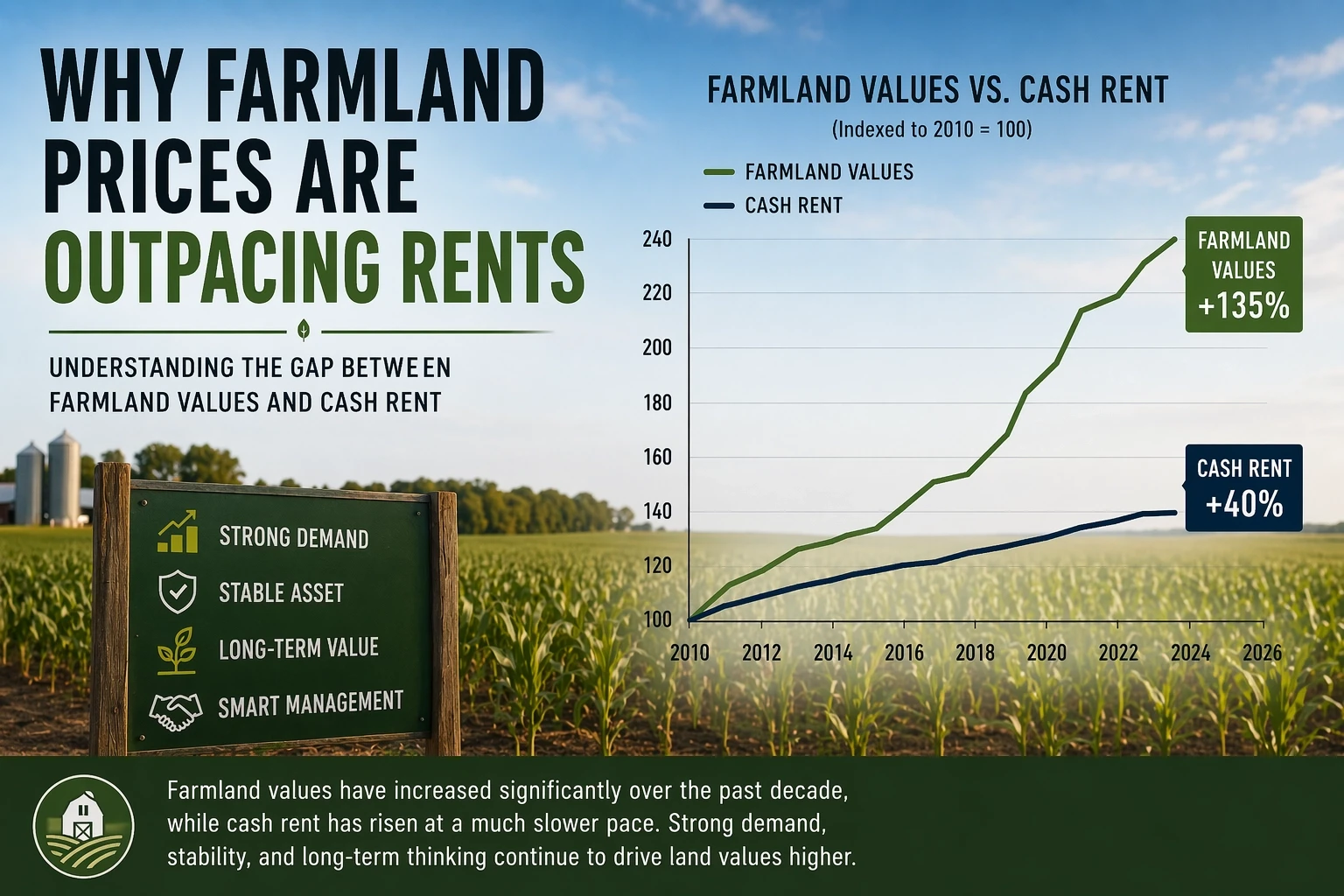
But over the past decade and especially in the last few years—we’ve seen a shift. Farmland prices have increased at a much faster pace than farmland rent, and that gap is starting to impact how landowners, tenants, and investors approach farm management.
Understanding why this is happening is critical if you own cropland, lease ground, or are considering buying farmland in today’s market.
The Relationship Between Farmland Values and Cash Rent Has Changed
Historically, farmland values were closely tied to income.
If a farm could generate more cash rent, it was worth more. If margins tightened, land values reflected that.
Today, that relationship still exists but it’s not as strong as it once was.
We’re seeing:
Continued growth in farmland prices
Slower increases in cash rent and farmland rent
A widening gap between land value and income
In practical terms, farmland is selling for more than what the rent alone would justify. Farmland is no longer being valued strictly on income, it’s being valued as a long-term asset.
A Shift Toward Total Return in Farmland Investing
One of the biggest drivers behind rising farmland prices is a shift in how buyers evaluate return.
Instead of focusing only on cash rent yield, buyers are looking at total return, which includes:
Annual income from farmland rent
Long-term appreciation of cropland
In many cases, appreciation is expected to make up the majority of the return.
This is especially true for buyers who view farmland as:
A long-term investment
A stable asset class
A hedge against inflation
Because of this, investors are often willing to accept lower cash rent in exchange for long-term land value growth.
Increased Demand for Cropland From Investors
Another major factor pushing farmland prices higher is increased demand from outside investors.
Today’s farmland buyers often include:
High-net-worth individuals
Institutional investors
Investment groups
Out-of-state buyers
These buyers are less dependent on farmland rent income and more focused on:
Wealth preservation
Portfolio diversification
Long-term land appreciation
As a result, they are often willing to:
Pay more per acre for quality cropland
Accept lower initial rent returns
Hold land for longer periods
This added demand continues to push farmland prices upward, even when rent growth is limited.
Farmland as an Inflation Hedge
Inflation has played a major role in farmland value trends.
When inflation rises, investors typically look for hard assets—assets that:
Have limited supply
Retain value over time
Provide long-term security
Farmland checks all three boxes.
There is a limited supply of productive cropland in regions like Indiana and Michigan, and demand for food production continues to grow.
Because of this, farmland is increasingly viewed as an inflation hedge, which brings more capital into the market and supports higher land values.
Why Cash Rent Moves More Slowly Than Land Values
While farmland prices are influenced by broader investment trends, cash rent is still tied to farm-level economics.
Farmland rent depends on:
Commodity prices
Input costs
Crop yields
Overall farm profitability
Unlike land values, which can be driven by outside capital, rent has to remain sustainable for the farmer.
From a farm management standpoint, this is critical.
If land rent is pushed too high:
Tenant risk increases
Margins tighten
Long-term land productivity can suffer
That’s why farmland rent typically adjusts more gradually than land values.
Farm Management Strategies in a Rising Land Market
As the gap between farmland prices and rent grows, farm management becomes more important than ever.
Today, managing farmland effectively requires more than just setting a rent number.
It involves:
Understanding local farmland rent trends
Evaluating tenant performance
Protecting soil health and productivity
Structuring leases that balance income and risk
Many landowners are moving beyond traditional fixed cash rent agreements and exploring:
Flexible cash rent leases
Bonus rent structures
Hybrid lease agreements
These approaches allow landowners to capture upside in strong years while maintaining stability in weaker markets.
Long-Term Demand for Farmland and Cropland
At the core of farmland value is long-term demand.
Productive cropland is essential for:
Food production
Livestock feed
Biofuels and energy
As global demand continues to increase, the need for high-quality farmland remains strong.
This long-term demand supports farmland prices, even in periods where farm income or rent growth slows.
What This Means for Landowners and Investors
If you own or are considering investing in farmland, it’s important to adjust your expectations based on today’s market.
1. Cash Rent Is Only Part of the Return
Farmland rent is important, but appreciation plays a larger role than it used to.
2. Focus on Long-Term Value
Well-managed farmland will perform better over time.
3. Use Smart Lease Structures
Flexible leases can improve returns without increasing risk.
4. Understand Your Local Market
Farmland values and rent vary significantly across Indiana and Michigan.
5. Prioritize Strong Farm Management
Good management protects both income and long-term land value.
Conclusion: Why Farmland Prices Continue to Outpace Rent
The gap between farmland prices and cash rent is not a short-term anomaly it reflects a broader shift in how farmland is valued.
Today, farmland is seen as:
A long-term investment
A stable asset
A hedge against inflation
At the same time, cash rent remains tied to the realities of farming, which limits how quickly it can rise.
Understanding this dynamic is key to making informed decisions in today’s farmland market.
Work With a Farmland Expert in Indiana and Michigan
If you’re a landowner or investor trying to navigate:
Farm management decisions
Farmland rent and lease structures
Buying or selling cropland
Long-term land strategy
I’d be glad to help.
I work with clients across Indiana and Michigan to maximize the value and performance of their farmland.
Contact me today to discuss your farm or investment goals.
—
Nolan Sampson
Farmland Real Estate Agent & Farm Manager
Indiana & Michigan

Nolan Sampson
Author